Botanical art has a reputation problem. Mention it in a room full of interior designers and someone will picture a Victorian library, a mahogany sideboard, a slightly dusty herbarium print. That image is the reason so many people overlook it entirely when decorating a sleek, light-filled flat — and it is almost entirely wrong.
The contemporary botanical print has very little in common with its ancestors. Rendered with precision line-work and deliberate restraint, today's botanical wall art sits just as comfortably in a Japandi bedroom as it does in a gallery-white living room. The trick is knowing which style of print to choose, what size to hang and how to frame it — and that is exactly what this guide covers.
Monochrome vs. Botanical Watercolour: Which Reads as 'Modern'?
This is the single most important distinction to understand before you buy. Not all botanical prints are created equal, and the difference between a piece that feels antique and one that feels sharply current comes down to rendering style.
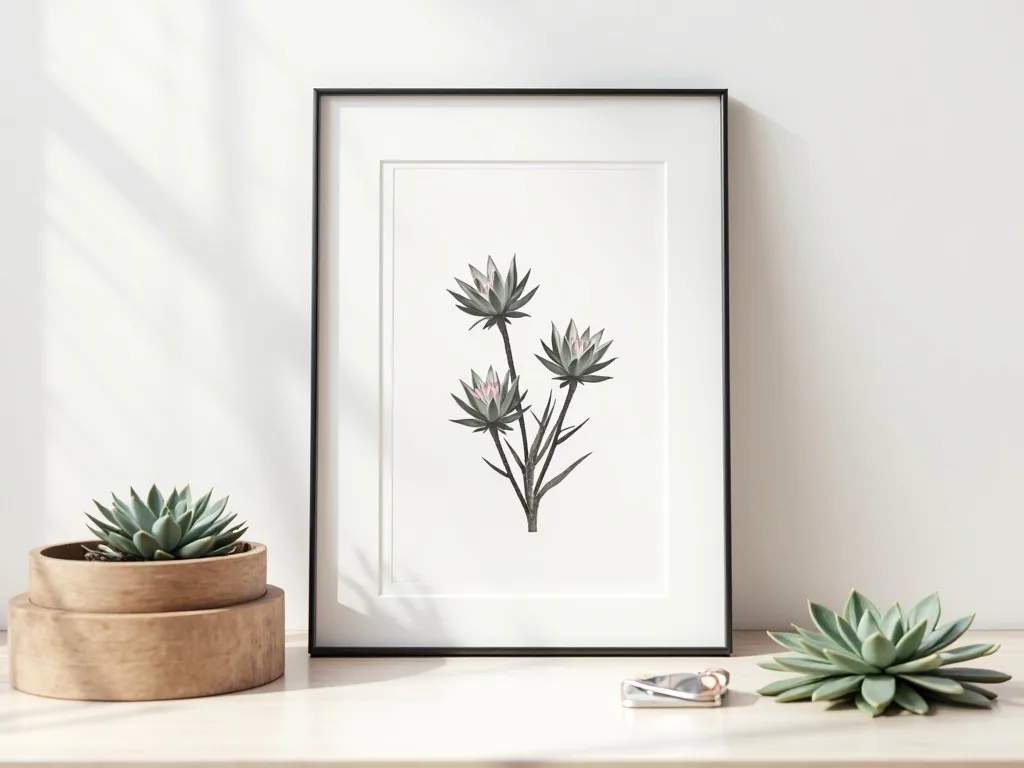
Fine-line monochrome prints — high-contrast black on white (or white on near-black), with no tonal wash — are the natural partners of Scandinavian and Japandi interiors. They strip the subject down to structure: the geometry of a Sempervivum rosette, the mathematical spiral of its leaves. On a white or pale plaster wall, a monochrome botanical print reads as graphic art first, nature study second. The effect is calm, intentional and unmistakably modern.
Watercolour-style botanicals, by contrast, carry warmth and softness. They work beautifully in modern-bohemian or eclectic spaces where you want texture and a sense of the hand-made. They can feel dated in a strictly minimalist room, but in the right context — paired with raw linen, terracotta and aged brass — they become an anchor, not a relic.
For purely minimalist interiors, lean monochrome. For warmer, layered spaces, a muted sage-green or dusty botanical rendering earns its place.
The Frame Changes Everything — Here Is the Math
A digital download gives you the same art file regardless of how you print it. What the frame does to that file is remarkable — and entirely within your control.
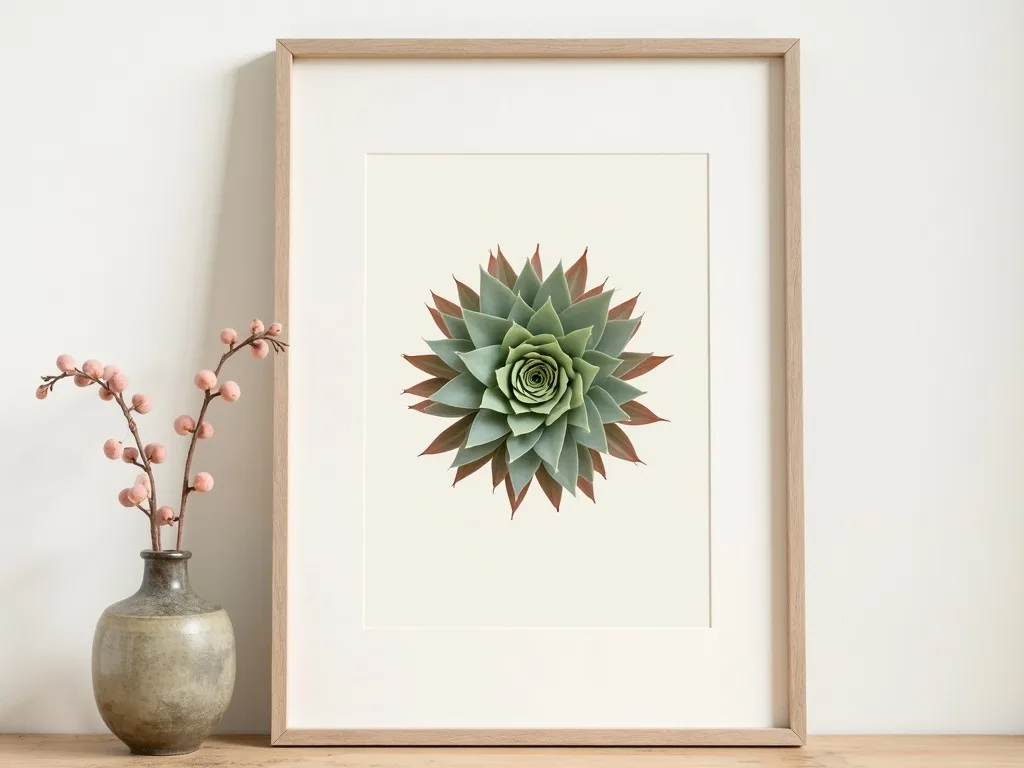
Take a 30×40 cm Sempervivum print. Hang it in a slim black frame (10–12 mm profile) against a bright white wall and the result is graphic, almost architectural — the kind of piece you might see in a Copenhagen studio flat. The narrow frame disappears and the art floats. Now place the identical print in a natural oak frame (15–18 mm profile) against a warm grey wall — suddenly the same design feels organic, textural, closer to Japandi or Wabi-sabi in spirit. Same file, completely different room personality.
A few rules of thumb worth bookmarking:
- 30×40 cm is the most versatile single-print size for a living room or hallway. It commands a wall without dominating it.
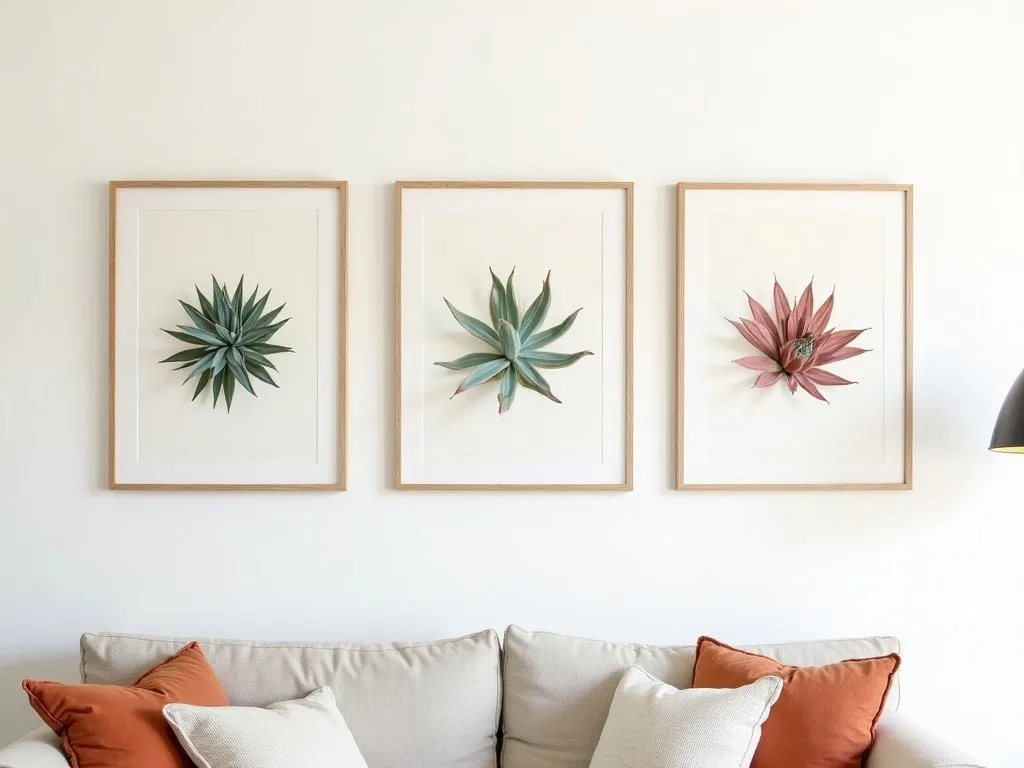
- 21×30 cm (A4) is ideal for groupings of three or more — enough detail to reward close inspection, compact enough to cluster tightly.
- 50×70 cm works as a centrepiece above a sofa or bed, but only if the wall is uncluttered on either side.
- For black frames, a white or off-white mount/mat adds breathing room and prevents the print from feeling compressed.
- For oak or natural wood frames, skip the mount and let the art edge sit closer to the frame — the warmth of the wood becomes part of the composition.
Room Case Study 1: Japandi Bedroom, Three Prints, One Statement Wall
The brief: a bedroom with white-painted walls, a low platform bed, undyed linen bedding and a single bedside pendant in brushed brass. The owner wants art that reinforces the stillness of the room without breaking it.
The solution: three monochrome Sempervivum botanical prints, each 21×30 cm, in matching slim black frames (no mount). Hung in a horizontal row, centres aligned at 155 cm from the floor, with 8 cm of space between each frame. Total spread: roughly 86 cm — proportional to a standard double bed width without overwhelming it.
The monochrome botanical prints echo the linear quality of the room's architecture. The succulent rosettes bring in organic softness without colour complexity. The result is quiet, precise and deeply considered — which is exactly what Japandi asks of every object in the room.
Room Case Study 2: Modern-Bohemian Living Room, Mixed Sizes, Mixed Frames
The brief: an open-plan living room with off-white walls, a curved sage-green sofa, rattan side tables and an abundance of real houseplants. The owner wants wall art for the living room that adds depth, not decoration.
The solution: a loose gallery cluster of three botanical prints in muted sage and warm ivory tones — one at 30×40 cm as the anchor, one at 21×30 cm slightly lower and offset to the right, one at 15×20 cm tucked close. Each in a different brass or antique-gold frame, none matching exactly. The slight variation in frame finish (some burnished, some matte) reads as collected rather than assembled.
The botanical subject matter — Sempervivum in soft, earthy tones — ties back to the living plants in the room and creates a visual conversation between the art and the space. No single piece needs to be perfect; the group is the composition.
Downloading and Printing: What to Know Before You Hang
Every print in the Flora Digital collection is a high-resolution digital file, available as an instant download. You print locally — at a print shop, a copy centre or at home on quality paper — which means you choose the paper weight, the finish (matte almost always wins for botanical art) and the exact size that fits your frame.
For the best result at 30×40 cm and above, ask your print shop for 200–250 gsm uncoated or fine-art matte paper. For smaller sizes like 21×30 cm, 170 gsm works well and keeps the print light enough to hang without anchoring hardware.
There is no waiting for shipping, no risk of damage in transit, and no minimum order — which makes it easy to print a test copy, live with it for a week and decide on framing before you commit.
Ready to find the print that fits your room? Browse the full range of Sempervivum botanical wall art — monochrome, tonal and everything between — in the Flora Digital botanical collection. Not sure which sizes work together on your wall? Try the gallery wall planner to map out your arrangement before you print a single sheet.